
Love Your Breasts, Candy Before Men & Other Lessons from My Summer Working in a Nursing Home
Featuring wheelchairs, tuna salad, and the ugliest uniform I've ever been forced to wear

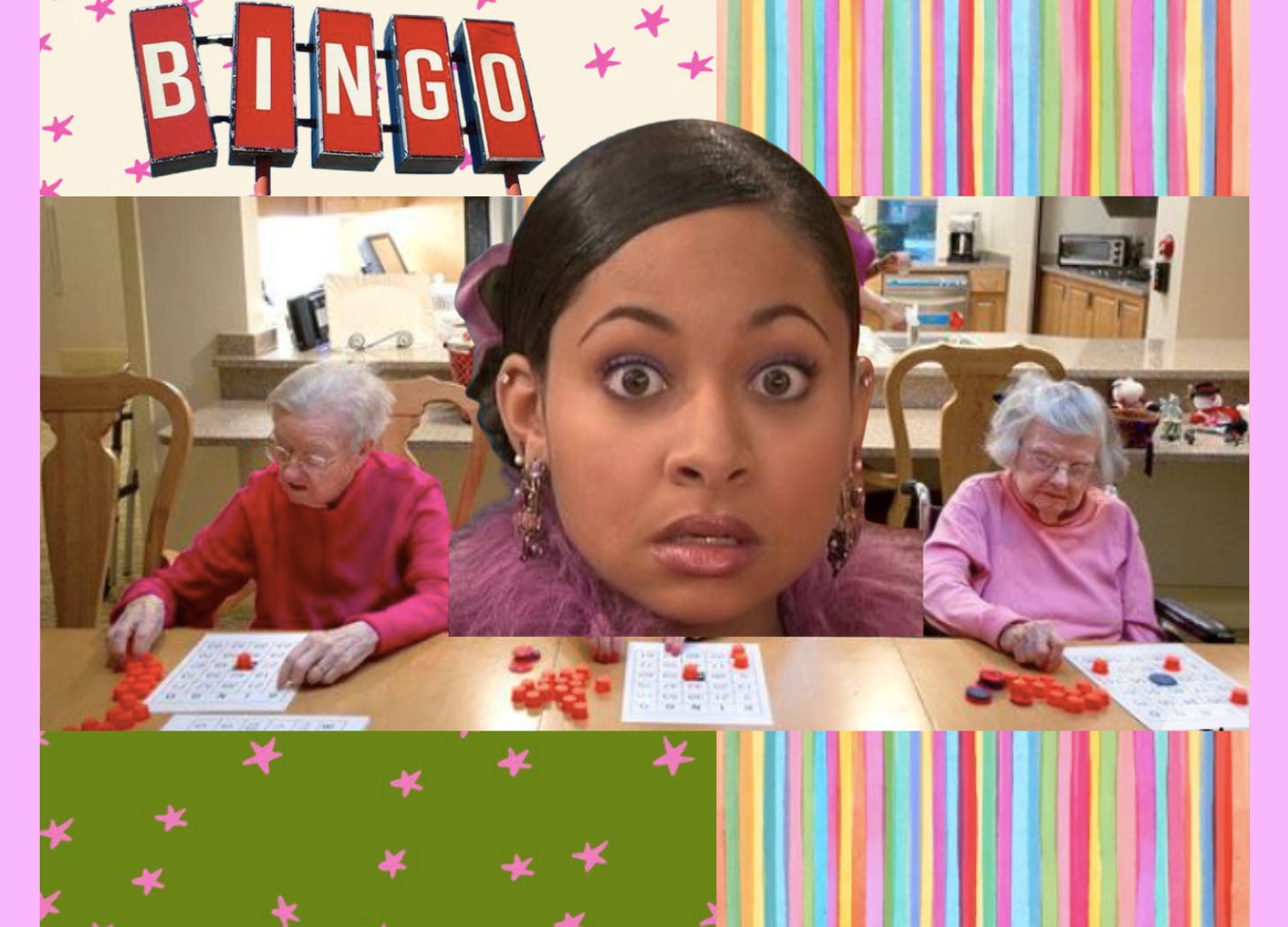
“These days their hair is longer than their skirts,” an elderly woman whispered to her friend as I walked by, although it wasn’t really a whisper, more like a from-the- diaphragm shout that I pretended I didn’t hear as I went by. I was arriving for an interview at The Margaret Residence, a memory care nursing home where I hoped to spend the summer working. Nineteen years old and back home after my first year of college that I spent partying and making a series of escalatingly bad decisions, I was determined to do something tangibly good for humanity (and beneficial to my pre-med major). Shaking off her comment, I swanned in and aced the interview which was conducted by the owner’s son, a burly frat boy who asked what bars I liked and oh, did I know that all the residents had dementia or Alzheimer’s and could I change a diaper? Yes and yes, I boldly claimed.
I was gathering my things in the lobby when an older gentleman addressed the family visitors and residents in the vicinity and asked if anyone drove a white Volkswagon. “Um, I do,” I answered, a slow panic rising in me. He rushed over, anxiously apologetic. “I am so sorry but I lost control of my father’s wheelchair and it crashed into your car and left a few dents, very minor but visible on the left side. I’m so sorry,” he gushed. “Oh my gosh, don’t worry about it,” I reassured him while internally my worry ratcheted higher and I pictured the irate lecture I would get from my mom, the owner of said brand-new car. The next day I had the pleasure of driving it over to Acci-DENT and begging them to fix it for less than my last paycheck.
And that was just the interview. Somehow undeterred, I launched into the job. While my peers got swanky internships and drank beers under Midwestern starlit skies, I spent the summer wiping adults with varying degrees of memory loss. I had to wear an unsightly blue smock that was an affront to my teenage vanity which was bolstered slightly when one day the janitor, at least twenty years my senior, asked me if I wanted to “catch a movie sometime.” I worked the five-to-eleven p.m. shift which covered getting all the residents to dinner, feeding them, getting them all bathed and into bed, then doing their laundry. This may not sound like much, but I was responsible for eight to ten residents every shift and I don’t know if you’ve ever wrangled a picnic- blanket-sized diaper onto a semi-paralyzed person but it is not easy or quick work. Just getting a resident from one chair to another, or changing their shirt, or spoon-feeding them dinner could take the lion’s share of an hour. Bedtime was the worst. Some nights I would spend an hour cajoling and coaxing a resident into bed only to later find them in another resident’s closet as I put away their laundry. If I had a dollar for every time my heart restarted when I found a resident silently standing between hangers I could have quit the job.
It wasn’t glamorous work. It was physically taxing and often frustrating, alarming, and sometimes just scary, but also very intimate and humbling. It wasn’t necessarily the time I spent with the residents that made me love them so much but the intimacy of where I was meeting them. At nineteen I had never been tasked with helping someone almost entirely dependent on me. I quickly realized I had no idea what I was signing up for and could not have predicted how profound and lasting the lessons would be, or how fiercely I would come to love each of my singular, astonishing residents.
There was Lucille, a copper-haired woman who loved vodka, candy, and men, and stringently declared they were in that order. She had lived in Greenwich her whole life but came to the residence to be near family when her dementia escalated. When her husband died, she told me, he looked so fragile in his bed that she was afraid to touch him, but the nurse encouraged her to. “I held him so tight,” she told me, “I’m glad I did.” A few seconds later she told me the story again as I helped her into her pajamas, and then again as I settled her into bed. Once when I was giving her a shower she told me that in her girlhood she hated her breasts and insisted to her mother that she was going to “chop them off” but her mother wouldn’t let her. “Love your breasts!” she told me with wide-eyed urgency, and you know something, I really do.
There was Larry, who was on a liquid-thick diet, which meant all his food had to be puréed and I won’t lie, it was a harrowing experience feeding him, particularly if the menu featured any kind of egg or tuna salad. I sat there in my stupid smock spoon- feeding him at a painfully slow rate and tried not to look at the slop but rather imagine how I’d feel if I had no choice what I ate for dinner and no ability to physically put it in my mouth so some random teenager home from college had to do it.
There was Dottie, who had a glass eye and an affinity for birds and John, who was slightly problematically in love with her.
There was Marilyn, who hated me with dedicated passion until she found out my uncle was the pastor who came to do her home visits, and trust I milked that connection for all that it was worth. The reward for earning her favor was that she allowed me to give her her whirlpool baths with marginally less yelling and correcting where I put her ointment (the details of which are best left undisclosed).
Then there was Dorcas. I know you’re not supposed to have favorites, but I loved Dorcas. Dorcas was pretty much entirely unable to move her body on her own which meant I spent proportionately more time with her than any of the other residents. She had late-stage Alzheimer’s and I don’t think she ever really knew where she was but she was always happy to be there. She had two singular teeth like telephone poles on opposite sides of a street and loved cookies. Her husband lived in the assisted living facility across the street and I used to push her over every day to visit with him. I remember wondering, when my mom’s car got hit, how one “loses control” of a wheelchair. I learned the hard way one evening when, as I pushed her over to see her man, the edge of her wheelchair got caught in the groove of a manhole and I watched in abject terror while it lurched perilously on one axis and for a horrifying second I thought I was sending Dorcas to meet her maker. But it was not her time.
It was two summers later that my mom, visiting her own mother at the assisted living facility, discovered that Dorcas had died. When she told me, I shocked myself by bursting into tears. I immediately recalled a time I’d spent ages getting a fresh Depends on Dorcas only for it to rip in half as I was almost done securing the tabs. “Shoot I’m so sorry Dorcas,” I told her, frustrated beyond comprehension, “We’re gonna have to start over.”
“Cookies!” she shouted in response, a huge grin on her face, and we both laughed.
It was Dorcas who taught me that difficult people are fun. I was endlessly surprised that summer to find that my favorite residents were the most mercurial, temperamental, stubborn, feisty ones. When everything else had swum away they still had some essential steel, a sparkling flint of character that made them resistors and defiants and I loved them for it even if it meant I heard the same story fifteen times in a row or had to put them to bed five times in a night.
Her death put me back in that summer, one that was punctuated by death in a way I had never experienced before. It was an inescapable reality, that our bodies and minds are constantly moving toward decay and death. I was learning that in specific, unavoidable truths. I remember tucking rolled washcloths under the residents’ hands at night to prevent worsening arthritis. I remember blasting Harry Styles’ “Sign of the Times” with the windows down on my drive home to blow out the smell of urine. I remember discovering that urine has an odor but urine in a diaper has a particularly pungent and distinct odor similar to but more chemical than the butter topping they put on movie theater popcorn. I remember fighting a lot with my family that summer, and wondering why people need so much.
I remember one night in particular, when I walked into a resident’s room and my heart rate hit the triple digits as I took in the scene. He’d had an accident and there was poop on the duvet, on the carpet, on his pants, in his hair, on his hands, the scent of it suffocated the room. I thought about calling the other caregiver to help me but then she would get off schedule putting all her residents to bed. I was so overwhelmed I wanted to cry and so perturbed I felt frozen in place. I wanted to pretend I hadn’t seen it and walk out of the room and the residence and back into a normal teenager’s life.
The residence had a slogan, which I believe is a Mother Teresa quote, that “Nothing is beneath you and nothing is too much for you when you’re doing it for someone else.” I took a deep breath of the shit-scented air and rolled up my sleeves. “Okay Paul,” I said, “Let’s get you ready for bed.”
“Why are you calling me Paul?” he asked.
“Oh I’m sorry,” I said, “Mr. Brenner.”
“No,” he said, “Why don’t you call me Dad?”
There are experiences that take you out of your life and then put you back in it as someone different. I didn’t leave the room because I simply couldn’t leave Paul, a person whose dignity and safety were entirely at the mercy of someone else, a man whose intelligence and personhood had been atrophied by one of the cruelest illnesses there is. I wondered what his daughter would want me to do in that moment, and did that. Then I went home and boiled myself in the shower.
I learned a lot that summer but the lesson that was the hardest and most permanent is that the work of taking care of another human being is the only work there really is to do while we’re here. It can take myriad forms, but we cannot avoid it. When the opportunity comes, don’t flinch. Don’t go find someone else to get you out of it. Engage with it, like up-to-your-elbows-in-bath-water-and-someone-else’s-poop engage with it. When you do, the gifts are manifold. I learned patience, a sense of humor about the ugly bits, respect for the body I need to last me, and tremendous gratitude for every time I was on the receiving end of someone’s generosity, gentleness, or care.
When it’s just you and another human being who looks up at you, totally reliant and asking for help, there’s a circle drawn around it. It’s an experience that belongs exclusively to the players in it and in some essential sense can’t be translated. That’s the story, as best I can tell it, but it was just he and I in that room, in that specific moment. We shared something ephemeral and singular and very brief. Our two lives, started at widely separate points on the timeline and still astonishingly, distinctly converging, then diverging again. It’s something, that nine years later I still think about that summer and can’t quite figure out what it meant or why I feel it all happened exactly as it was supposed to.
I live in Manhattan now, which at nineteen I thought was the most glamorous thing a person could do (very satisfying to find out- it is). People are always doing glamorous things like getting eight-hundred-dollar “creamy vanilla” highlights or going on a date with David Harbour (in the thick of his scandal) or having a personal shopper select their spring wardrobe. I toured Equinox the other day and caught myself wondering if I was being influenced by the materialism of Manhattan when I could run for free ninety nine on the West Side Highway. I spend too much money on clothes and fancy dinners and have had quite a lot of fun getting lost in the glitter of my new life.
I rarely talk about my old brush with care work (hard to naturally segue into denture cleaning and whirlpool baths) and sometimes actually find myself a little embarrassed, as if the experience were beneath me. Nothing is beneath you, when you’re doing it for someone else, I sometimes have to remind myself.
Who knows, maybe I’ll wind up spending my golden years in memory care back in the Midwest, babbling about my days running around the Lower East Side and how it took me a few extra years to pay off my college loans because cocktails were twenty-five bucks while a college freshman rolls her eyes and spoon-feeds me pudding. Maybe I’ll get as good as I gave, and I’ll discover what it’s like to be totally at the mercy of someone else. I’ll finally understand why people need so much and be better for it.
The untouchable, everlasting, impervious feeling that dominated my teens has evaporated with age. I didn’t understand it then but I do now, how scary it feels to express a need of any kind, a necessity that risks standing defined but unmet. There was no point after I left that job when I felt my life had clicked back into normalcy. Normal life has suffering in it. Accepting that tempers the bitterness a little. It frames the good moments, in all their sparkling, painless joy. It’s good to need. It’s good to be needed. It makes us both fallible and beholden, and that makes us human, which we are very lucky to be.
Now I’m gonna go throw on a push-up bra and make myself a vodka martini with a candy chaser. Cheers to you for making it to the end of this essay! Thank you endlessly for reading.
Now THIS deserves to go viral. Just wow. That was beautifully shared.
so beautifully written!! made me cry 🫶🏻